
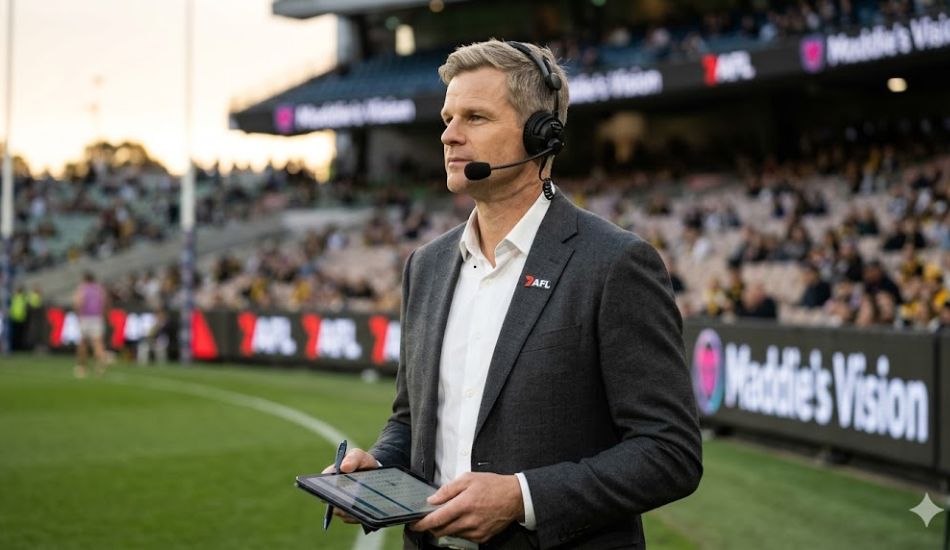
The Ultimate Professional: The Life and Legacy of Nick Riewoldt
In the pantheon of Australian Rules Football, few names command as much universal respect as Nick Riewold. A man whose career was defined by an almost superhuman work ethic, a courageous playing style, and a leadership quality that transcended the boundary lines, Riewoldt has become a symbol of resilience in the modern era. From being the number one draft pick to becoming the heart and soul of the St Kilda Football Club, and now a premier voice in sports media, his journey is a masterclass in professional excellence and personal character.
The Early Years: A Prodigy in the Making
Born on October 17, 1982, in Hobart, Tasmania, Nicholas Frederick Riewold was born into a family with deep footballing roots. However, it was on the sun-drenched Gold Coast of Queensland where his sporting prowess first began to flourish. Interestingly, Riewoldt’s first love wasn’t Australian Rules; he was a talented soccer player and an all-around athlete, excelling in cricket and athletics.
His transition to football was rapid and dominant. By the age of 17, playing for Southport in the AFL Queensland competition, Riewoldt was already being touted as a “once-in-a-generation” talent. His combination of height (193 cm), elite endurance—honed through years of cross-country running—and a safe pair of hands made him the consensus choice for the number one pick in the 2000 AFL National Draft. When the St Kilda Football Club called his name, they weren’t just picking a player; they were selecting the foundation of their future.
The St Kilda Era: A Legend in Red, White, and Black
Riewoldt’s debut season in 2001 was hampered by injury, but the following year, the “blonde flyer” took the competition by storm. He won the AFL Rising Star Award and his first Trevor Barker Award (St Kilda’s Best and Fairest) in 2002, becoming the youngest player to win the club’s top honor since the legendary Trevor Barker himself.
What followed was a seventeen-season odyssey that saw Riewold redefine the role of a modern center-half-forward. Unlike traditional forwards who waited for the ball, Riewold game was built on “work rate.” He would often sprint from the goal square to the defensive 50, dragging his opponent into the “deep water” of exhaustion before doubling back to take a contested mark.
By the time he hung up his boots in 2017, his statistical resume was staggering:
-
336 Games: Placing him among the elite few to pass the 300-game milestone.
-
718 Goals: Cementing his place as one of the most prolific scorers in history.
-
Most Marks in AFL History: A record that highlights his incredible aerial ability and relentless lead-up play.
-
6x Trevor Barker Awards: A club record that underscores his consistency over nearly two decades.
-
5x All-Australian: Recognition as the best in his position across the entire league.
Leadership and Heartbreak
Riewoldt was appointed captain of St Kilda at just 22 years old in 2005. He went on to lead the club in 220 games—the longest tenure in the club’s history. Under his leadership, the Saints entered a golden era of competitiveness, reaching the Grand Final in 2009 and twice in 2010 (following a famous draw against Collingwood).
While a premiership medallion famously eluded him, Riewoldt’s legacy was never about the silverware he lacked, but the standards he set. He famously played through agonizing injuries, including a horrific collision in 2004 against Sydney that became one of the most iconic “courageous marks” in AFL history. To Saints fans, “Rooey” was the lighthouse that kept the club steady through turbulent times.
A Legacy Beyond the Field: Maddie Riewoldt’s Vision
While his football achievements are immense, perhaps Nick Riewoldt greatest contribution to Australian society came through personal tragedy. In February 2015, Nick’s younger sister, Maddie, passed away at the age of 26 from complications related to Aplastic Anaemia, a rare bone marrow failure syndrome.
In the wake of her passing, Nick and the Riewoldt family established Maddie Riewoldt’s Vision. The foundation was built on Maddie’s dying wish: that no other family should have to endure the same fight. Nick took on the role of Deputy Chair, using his massive public profile to raise millions of dollars for medical research.
The annual “Maddie’s Match”—a fixture between St Kilda and Richmond (where Nick’s cousin Jack Riewoldt played)—has become a cornerstone of the AFL calendar. As of 2026, the foundation has funded dozens of research fellowships and clinical trials, significantly improving the survival rates and treatment options for patients with Bone Marrow Failure Syndromes (BMFS). For Nick, this work is the true measure of his impact—a legacy of hope that will save lives long after his football records are broken.
The Texas Sabbatical and Return to Australia
Following his retirement from the media landscape in 2022, Riewoldt made the surprising decision to move his family—wife Catherine and sons James, Will, and Teddy—to Houston, Texas. This “sabbatical” allowed Riewold to step away from the intense bubble of Melbourne football and experience life as an “average Joe” (albeit one working in high-level stadium technology with the PMY Group).
However, the pull of the game was too strong. In late 2024, it was announced that Riewoldt would return to Australia to join the Seven Network (Channel 7) as a marquee commentator.
The Voice of the Game in 2026
Returning to our screens in 2025 and continuing into the 2026 season, Riewoldt has cemented himself as the “gold standard” of sports broadcasting. He isn’t just a former player recounting “the good old days”; he is an analytical powerhouse. Whether he is breaking down complex defensive zones on The Agenda Setters or providing special comments during Thursday night blockbusters, his insights are sharp, objective, and deeply knowledgeable.
In early 2026, Riewoldt sparked a national conversation about the state of Australian junior sports. Drawing on his experience in the United States, he critiqued the Australian “participation trophy” culture. He argued that by not keeping score in junior levels, we are doing a disservice to children’s development.
“Kids know the score. They keep score in their heads anyway. By pretending winning and losing doesn’t exist, we’re removing the very lessons of resilience and improvement that sport is designed to teach.”
This outspoken nature—grounded in his own experiences as a father and an elite athlete—has made him one of the most influential figures in Australian public discourse today.
The Hall of Fame and Beyond
The crowning moment of his post-playing career arrived in 2025 when he was officially inducted into the Australian Football Hall of Fame. It was a foregone conclusion for a man who gave everything to the sport. As we look at the AFL landscape in 2026, Riewoldt’s influence is everywhere—from the way young forwards model their running patterns after him, to the medical breakthroughs funded by his sister’s foundation.
Nick Riewold remains a rare breed: a superstar who stayed humble, a competitor who played fair, and a brother who turned grief into a nationwide movement for good. Whether he’s in the commentary box or at a fundraising gala, he continues to lead with the same “all-in” mentality that once made him the king of Marvel Stadium.
For more in-depth profiles on Australian icons and the latest in sports culture, stay tuned to megacine. We take pride in bringing you the stories that matter, covering the intersection of sports, entertainment, and the human spirit. At megacine, we believe that figures like Nick Riewold represent the very best of our national identity.